
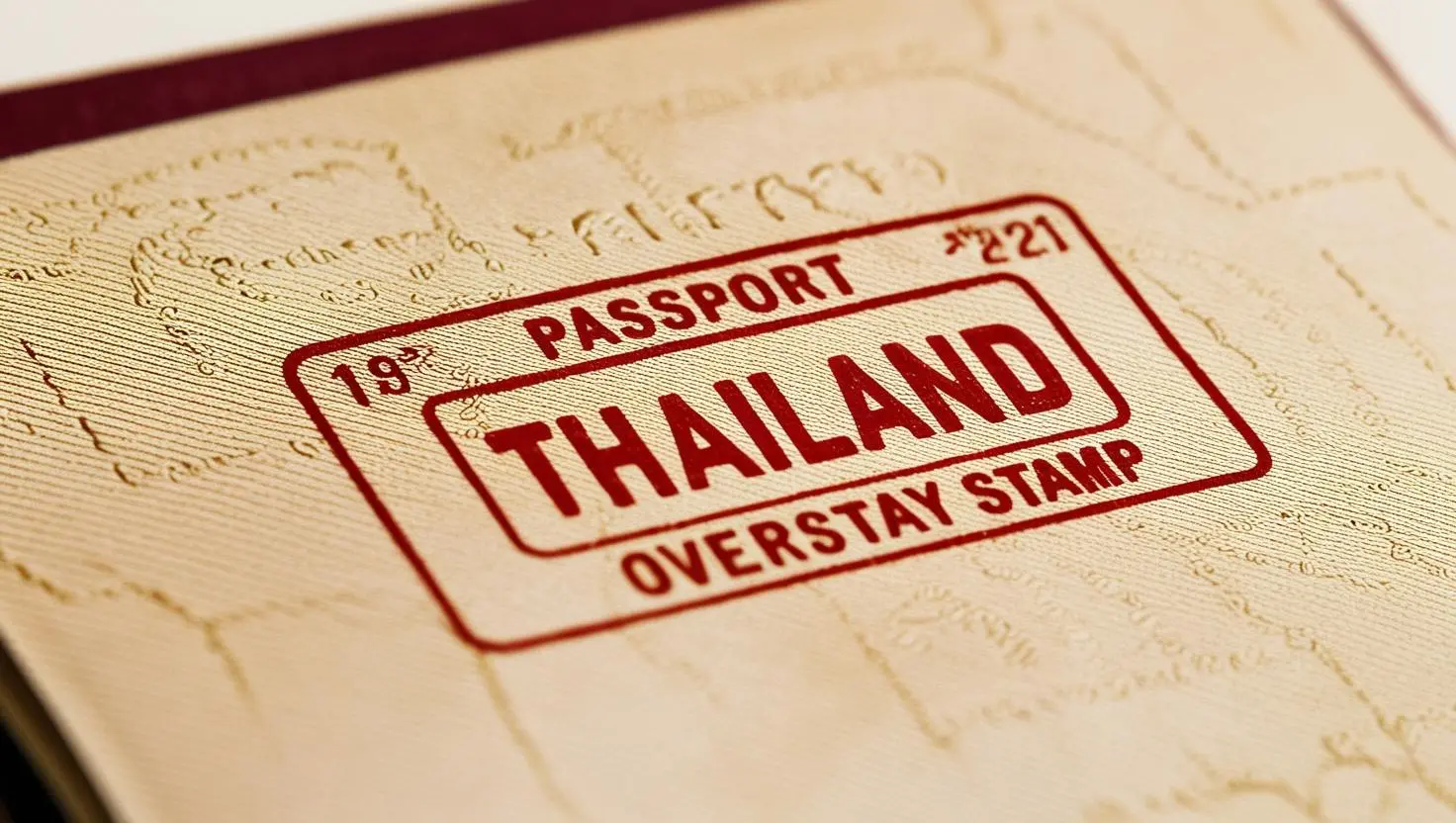
Overstay in Thailand: What Happens and What to Do
An overstay in Thailand is fined at 500 baht for each day, up to a maximum of 20,000 baht, which is reached after 40 days. An overstay of 90 days or fewer is usually settled by paying the fine at the immigration checkpoint on departure and leaving. Beyond 90 days, a ban on returning to Thailand applies as well, and a foreign national who is caught rather than coming forward faces deportation and a longer ban.
What Counts as an Overstay
The permitted stay ends on the date stamped or recorded in the passport on entry, or on the last day of any extension. An overstay begins the following day, whatever the basis of the stay: a visa, a visa exemption or an extension. Leaving on the date stamped is not an overstay, since that date is the last day of permitted stay.
Visa exemption periods changed on 15 September 2026. Citizens of 59 countries and territories now receive visa-free entry for tourism of up to 30 days, and citizens of Mauritius and Seychelles up to 15 days, replacing the former 60-day exemption. Travellers who entered before 15 September keep the stay they were granted on arrival. Details of the scheme are on our visa exemption page.
Overstays of More Than 90 Days Carry a Ban
An overstay is an offence under Section 81 of the Immigration Act B.E. 2522, carrying imprisonment of up to two years, a fine of up to 20,000 baht, or both. In practice, a foreign national who reports the overstay on departure settles it with a fine of 500 baht for each day, weekends and public holidays included, which stops rising at 20,000 baht once the overstay passes 40 days. The fine is paid at the immigration checkpoint on departure, whether at an airport or a land border.
The procedure is set by the Immigration Bureau. The passport control officer refers the traveller to the fines officer, who confirms the length of the overstay and the amount due. Once the fine is paid, the officer issues a receipt, records the payment, stamps the passport and returns it, and the traveller continues through departure. A traveller who refuses to pay is subject to further investigation. Allow extra time at the airport, and carry the amount in cash.
An overstay is avoided by applying for an extension of stay at an immigration office before the permitted stay ends. A foreign national who has already overstayed and intends to stay on, rather than leave, must settle the overstay at an immigration office as part of applying for a new visa or extension.
The Fine Is 500 Baht a Day, up to 20,000 Baht
A ban on re-entering Thailand applies to any overstay of more than 90 days. Its length depends on how long the overstay lasted and on whether the foreign national came forward or was caught.
| Length of overstay | Ban after coming forward voluntarily | Ban after arrest and prosecution |
|---|---|---|
| 90 days or fewer | None | 5 years |
| More than 90 days | 1 year | 5 years |
| More than 1 year | 3 years | 10 years |
| More than 3 years | 5 years | 10 years |
| More than 5 years | 10 years | 10 years |
The ban runs from the date of departure from Thailand and is recorded on the immigration blacklist. It does not apply to a foreign national who left Thailand before the age of 18.
The procedure is set by the Immigration Bureau. The passport control officer refers the traveller to the fines officer, who confirms the length of the overstay and the amount due. Once the fine is paid, the officer issues a receipt, records the payment, stamps the passport and returns it, and the traveller continues through departure. A traveller who refuses to pay is subject to further investigation. Allow extra time at the airport, and carry the amount in cash.
An overstay is avoided by applying for an extension of stay at an immigration office before the permitted stay ends. A foreign national who has already overstayed and intends to stay on, rather than leave, must settle the overstay at an immigration office as part of applying for a new visa or extension.
Being Caught Is Far More Serious Than Coming Forward
A foreign national arrested for overstaying faces a fine of up to 20,000 baht, may be detained until deportation, and is deported from Thailand. The ban that follows is five years for an overstay of less than one year and ten years for a longer one, far heavier than the ban for the same overstay reported voluntarily. For anyone who has overstayed, coming forward before being caught is almost always the better course.
Re-Entry Permits
A foreign national holding a long-term visa or an extension of stay, such as a Non-B, Non-O or Non-ED visa, must obtain a re-entry permit before leaving Thailand. Without one, the permission to stay ends on departure, and the traveller re-enters on whatever entry terms apply at the border, which may be far shorter. With one, the traveller returns to the remaining period of the original stay.
What to Do If You Have Overstayed
- An overstay of 90 days or fewer: go to the airport or border early, pay the fine at the immigration checkpoint and leave. No ban applies.
- An overstay of more than 90 days: come forward rather than wait to be caught, since the ban is far shorter. Take advice before going to Immigration.
- Wishing to remain in Thailand: the overstay must be settled before any new visa or extension is granted, so the right visa needs to be identified first.
Anyone who has overstayed, or is about to, should take advice before going to Immigration. We explain the options and can arrange the right visa for those who wish to stay. See our visa services or get in touch.
Reviewed September 2026
FAQs
How much is the overstay fine in Thailand?
500 baht for each day of overstay, up to a maximum of 20,000 baht, which is reached after 40 days. The fine is paid at the immigration checkpoint on departure, at an airport or a land border, and the officer issues a receipt and stamps the passport.
What happens if I overstay my visa in Thailand?
An overstay of 90 days or fewer is settled by paying the fine on departure. Beyond 90 days, a ban on returning applies, from one year upwards depending on the length of the overstay. A foreign national who is caught rather than coming forward is deported and receives a ban of five or ten years.
What happens if I overstay by one or two days?
The fine is 500 baht for one day or 1,000 baht for two, paid at the immigration checkpoint on departure. The officer issues a receipt and stamps the passport, and no ban applies. Allowing extra time at the airport avoids the risk of missing the flight.
Where do I pay an overstay fine in Thailand?
At the immigration checkpoint when leaving Thailand, at an airport or a land border, where the fines officer confirms the amount, issues a receipt and stamps the passport. A foreign national applying to stay on settles the overstay at an immigration office as part of the application for a new visa or extension.
Can an overstay be cleared or forgiven?
An overstay is settled by paying the fine. Any ban follows from the length of the overstay and from whether the foreign national came forward or was caught, so the most effective way to limit the consequences is to come forward before being caught, which keeps any ban far shorter.
Will I be banned from Thailand for overstaying?
Not for an overstay of 90 days or fewer that is reported on departure. Coming forward after a longer overstay brings a ban of one, three, five or ten years depending on its length. An arrest brings five years for an overstay under one year and ten years for a longer one.
What does an overstay stamp in my passport mean?
It records that an overstay fine was paid on departure. The payment is also held on the immigration system, and officers may take it into account on a future entry. A short overstay reported and paid on departure does not in itself prevent a return to Thailand.
Is it an overstay if I leave on the day my visa expires?
No. The date stamped in the passport is the last day of permitted stay, so leaving on that date is not an overstay. The fine applies only from the following day.